
PredatorShield
A patent-pending stationary marine protection system designed to help protect human-use waters through distributed sensing, non-lethal deterrence, live protection-state awareness, human-safety escalation, and resilient site engineering.
Detect & Track
Distributed cameras, sonar, and related marine sensors can contribute to a persistent target track as an animal moves along or toward a protected marine boundary.
Non-Lethal Response
Electromagnetic, acoustic, visual, and other authorized non-lethal deterrence may be coordinated according to target state and site conditions.
Protection Integrity
The system can distinguish between a healthy device and a protected region that actually has sufficient currently available deterrence capability.
Human Safety
If deterrence becomes insufficient, uncertain, constrained, or a target penetrates the boundary, human-warning, tracking, and water-clearance support can receive priority.
Every beach is different. The system should know that.
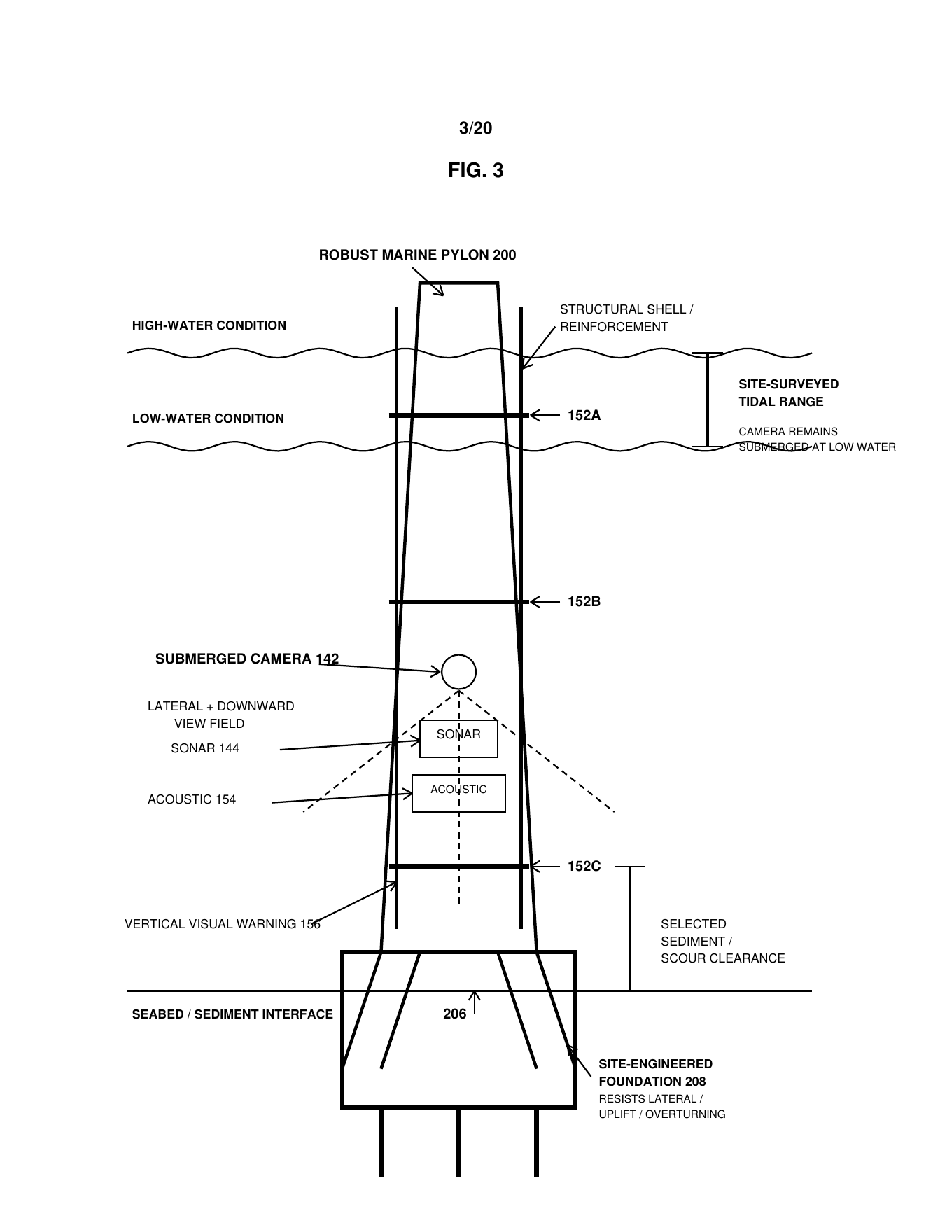
PredatorShield pylons are not intended to be one-size-fits-all hardware. Site engineering may account for tidal range, bathymetry, seabed conditions, sediment movement, scour, water clarity, environmental exposure, and the geometry of the protected region.
Preferred Pylon Architecture
- Fixed seabed-supported marine pylon
- Central submerged wide-field imaging placement selected for the site's low-water condition
- Upper, intermediate, and lower electromagnetic deterrence elements
- Lower EM clearance selected for sediment and scour tolerance
- Vertically distributed visual-warning elements
- Sonar and acoustic deterrence integration
- Shore/utility power with battery backup
- Site-engineered structural foundation and protected power/data routing
Built as coastal infrastructure, not beach furniture.
Preferred installations are conceived as robust marine structures engineered for site-specific wave, current, storm-surge, debris, uplift, overturning, corrosion, scour, sediment, and other environmental loads.
The design may account for hurricane, cyclone, tsunami, extreme-inundation, vessel-impact, and geotechnical conditions where applicable. PredatorShield is not represented as indestructible or guaranteed to remain fully operational through every extreme event.
Post-Event Verification
A pylon that still communicates is not automatically treated as structurally verified. Following a qualifying storm, impact, or seabed event, the system may require inspection, survey, sonar, camera, diver/ROV, position, tilt, or other structural verification before restoring the node's full protection contribution.
Grid + Battery Continuity
Normal shore or utility power can support operation while battery energy storage provides backup during an outage, with priority given to safety-critical functions.
Local Authorized Operation
Loss of remote or cloud connectivity need not terminate authorized local sensing, tracking, warning, deterrence, or protection-state functions.
BioSight
Protection-system observations may also support scientific collection of biological and environmental information, preserving original observations for later review and annotation.
Patent pending.
Banyan PredatorShield is the subject of U.S. Utility Patent Application No. 19/805,678, submitted September 12, 2026, with Confirmation No. 7509. The application claims benefit of U.S. Provisional Patent Application No. 64/121,034, filed July 28, 2026.
Public disclosure boundary
This page presents a non-confidential overview only. Technical implementation details, engineering values, control logic, installation parameters, and additional protected subject matter may be omitted from public presentation.